Industrial cashew roasting uses three main methods — rotary drum (dry) roasting, hot-oil-bath roasting (in cashew shell oil), and continuous oven roasting — generally at around 180–200 °C. Which one you use depends on the goal: drum and oven roasting develop flavour and drive off moisture in the finished kernel, while oil-bath roasting of the shell is really a way to extract CNSL and condition the nut. Roasting is different from steaming or boiling, which only soften the shell — roasting applies dry, higher heat. This page compares the methods, their temperatures and times, and when to use each.
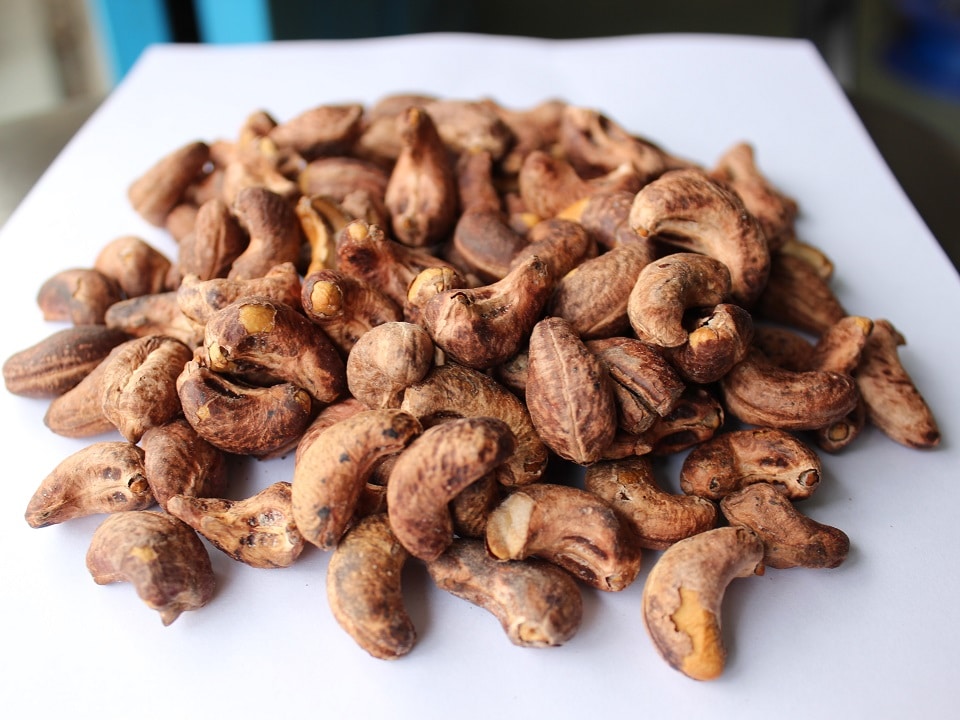
Roasting vs Steaming vs Boiling
Steaming and boiling condition the shell (softening it, neutralising CNSL) ahead of cutting, at around 100 °C with moisture. Roasting applies dry heat at 180–200 °C, either to the shelled kernel for flavour and finish, or to the whole nut in a hot-oil bath to extract CNSL. So conditioning comes first; roasting is a later, hotter step.
Method 1 — Drum / Dry Roasting
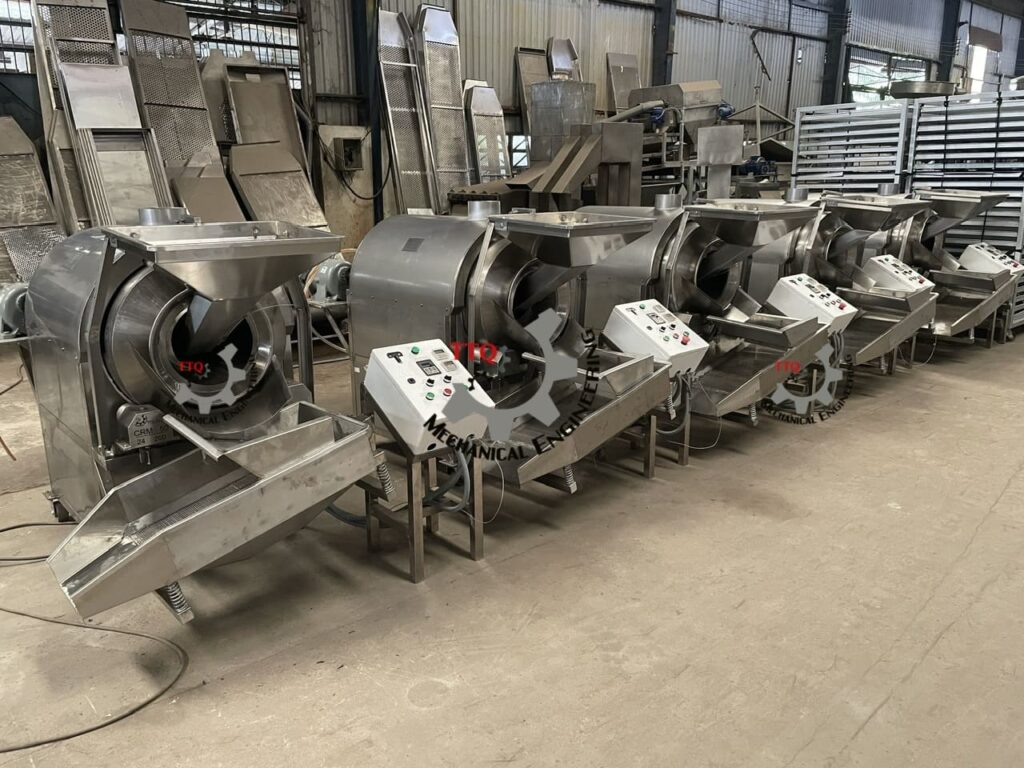
A rotary drum tumbles a batch of nuts while gas burners heat the drum, roasting at roughly 180–200 °C for 15–20 minutes. Drums hold anywhere from ~20 to 100 kg per batch, are usually stainless steel, and are digitally controlled for target temperature and roast level. Drum roasting is simple, gives a high whole-kernel rate and consistent batches — but it loses most of the shell’s valuable CNSL as fume and generates heat and acrid smoke in the workspace.
Method 2 — Oil-Bath (Hot CNSL) Roasting
Pre-conditioned nuts are passed, in wire baskets, through a bath of cashew shell oil held at about 180–200 °C for roughly 1.5–3 minutes. The hot bath extracts CNSL from the shell (which topped up the bath) and embrittles it for cutting. This method recovers the CNSL that drum roasting wastes, making it attractive where the shell oil is sold — see CNSL extraction.
Method 3 — Oven / Continuous Roasting
Continuous or oven roasters move kernels through a heated tunnel on a belt, giving steady, high-volume output with uniform colour. They suit flavour-roasting of finished kernels at scale and integrate cleanly into an automated line. Temperature and belt speed set the roast level.
Temperature & Time Guide
| Method | Temperature | Time | Output |
|---|---|---|---|
| Drum / dry | ~180–200 °C | 15–20 min | Flavour-roasted kernels; CNSL lost |
| Oil-bath (CNSL) | ~180–200 °C | ~1.5–3 min | Conditioned nut + recovered CNSL |
| Oven / continuous | Set by tunnel | Continuous | High-volume, uniform roast |
Finished roasted kernels are typically dried to a low moisture (around 3%) so they stay crisp.
Salting & Seasoning After Roast
For snack production, kernels are roasted with salt (often reused across batches) or seasoned after roasting, then cooled quickly on trays to stop the cook and lock in crunch. Cooling before packing prevents condensation and rancidity.
Choosing a Method
Choose by your objective: drum or oven for flavour-roasting kernels at volume; oil-bath where recovering CNSL from the shell matters. Many plants condition by steam for shelling and roast only the finished kernels for the snack market. The equipment side is on the cashew roasting machine page.
Frequently Asked Questions
What temperature do you roast cashews at? Industrial roasting runs at about 180–200 °C — drum roasting for 15–20 minutes, hot-oil-bath roasting for roughly 1.5–3 minutes. Snack roasters with salt often run a little lower.
How long to roast cashews? Around 15–20 minutes in a drum roaster, or 1.5–3 minutes in a hot-oil bath. Continuous oven roasters set the time by belt speed. Roast to the target colour and stop immediately.
Is roasting the same as steaming? No. Steaming conditions the shell at ~100 °C with moisture to prepare for cutting; roasting applies dry heat at 180–200 °C for flavour or, in an oil bath, to extract CNSL.
Do you roast cashews in the shell or shelled? Both, for different reasons. Whole nuts are oil-bath roasted in the shell to extract CNSL and condition them; finished kernels are drum- or oven-roasted (shelled) for flavour.