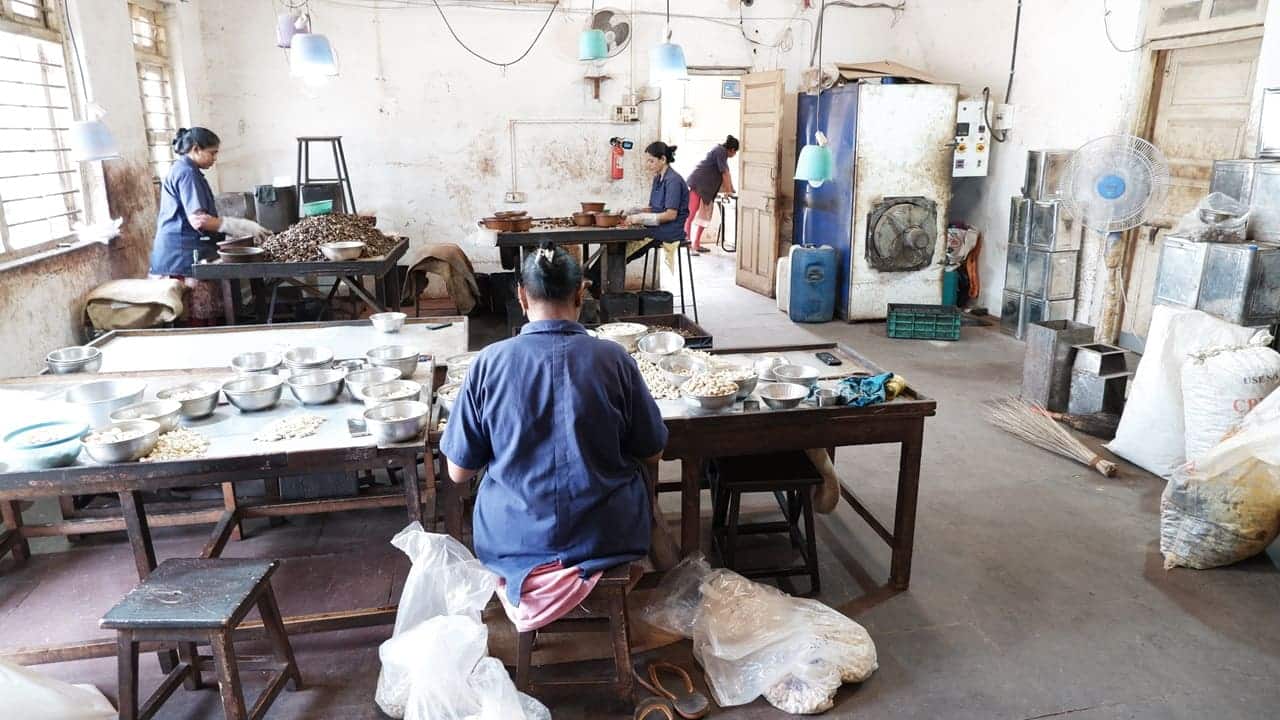
A turnkey cashew processing plant is a complete factory delivered under one contract — CASHEW TECH designs it, supplies every machine, wires and powers it, installs and commissions it on your site, and trains your operators, so you receive a working line that turns raw cashew nuts (RCN) into graded, export-ready kernels. We build plants from a 2-ton-per-day starter unit to a 50-ton-per-day industrial factory (raw nuts, single 8-hour shift), with a single point of responsibility from feasibility study to the day the first packed kernel comes off the line. This page sets out exactly what “turnkey” includes, the project journey, plant capacities, the utilities and electricals that come with it, and how we de-risk a first factory — especially for new processors in Africa and Asia entering the business for the first time.
Buying a plant piece by piece leaves you to integrate machines, power, steam, and layout yourself. A turnkey contract removes that risk: every stage is sized to match the next, one team is accountable for the whole line hitting its rated output, and you get to a running, revenue-earning factory faster.
What “Turnkey” Means for a Cashew Plant
Turnkey means you “turn the key” and the plant runs. Rather than a box of machines, you receive an engineered, balanced line plus everything around it: the process design, the electrical backbone, the steam and drying utilities, the installation labour, the commissioning to rated capacity, the operator training, and the documentation you need for buyers and auditors. The scope is single-source, so there is no gap between “the machine supplier,” “the electrician,” and “the person who makes it all work together” — that is all CASHEW TECH. For a first-time processor, that single accountability is the difference between a plant that reaches its outturn on schedule and one that stalls between vendors.
Scope of Supply — What’s Included
A turnkey contract is defined by its scope. The table below is the standard CASHEW TECH scope; any line can be tailored up or down.
| Area | Included in a turnkey plant |
|---|---|
| Process design | Mass balance, capacity sizing, machine selection, process flow |
| Layout & engineering | Factory floor plan, material-flow and HACCP zoning, utility routing — see factory layout & plant design |
| Machinery | Steaming, cutting & shelling, scooping, drying, peeling, grading (size sorting, optional colour sorting), packing — the full machine range |
| Steam & heat | Boiler or cashew shell burner sized to the line’s steam demand |
| Electricals | Main electrical control panel, PLC & power cabling (Siemens / Mitsubishi / Schneider) |
| Installation | On-site erection, alignment, and integration of every stage |
| Commissioning | Running the line to rated capacity and target outturn before handover |
| Training | Operator and maintenance training — see training, installation & maintenance |
| Documentation | Manuals, spares list, and the paperwork buyers and food-safety auditors expect |
| After-sales | Spare parts, remote support, and expansion planning |
Civil works (building, foundations, water) are usually done locally to our drawings; we coordinate the interface so the plant drops straight in.
The Project Journey, Phase by Phase
Every turnkey plant follows the same disciplined path, so you always know what happens next:
- Feasibility & project report — capacity, capex/opex, RCN sourcing, and ROI captured in a bankable project report (DPR) you can take to a lender or a subsidy scheme.
- Process & layout design — the line is engineered to your target output and your building.
- Manufacturing — machines are built and factory-tested to your configuration.
- Supply & logistics — crating, shipping, and customs support to your port and site.
- Civil coordination — you build to our drawings; we align the schedule.
- Installation — our team erects and integrates the line on your floor.
- Commissioning — the plant is run up to rated capacity and target whole-kernel outturn.
- Training & handover — your crew is trained; you receive documentation and spares.
- After-sales — ongoing support, parts, and a clear path to expand later.
Plant Capacity Tiers
We size plants across a wide range; the table gives indicative configurations (raw nuts per 8-hour shift). Exact machine counts are set in the design phase.
| Daily capacity (RCN) | Typical scale | Cutting stage | Automation |
|---|---|---|---|
| 2 t/day | Startup / small unit | 1–2 cutters | Manual / semi-automatic |
| 5 t/day | Small commercial | 2–3 cutters | Semi-automatic |
| 10 t/day | Mid-size factory | 4-cutter line | Semi- to fully automatic |
| 25 t/day | Large factory | Multiple automatic lines | Fully automatic |
| 50 t/day | Industrial | Multiple automatic lines + high-capacity utilities | Fully automatic |
A smaller plant can be designed to expand in stages, so early machines still fit when you scale up — the planning that saves buying twice. For a compact starter, see the small-scale cashew processing line; for the blueprint of a modern factory, the ultra-modern cashew processing unit guide.
The Line: Machine by Machine
A turnkey plant is a balanced sequence of stages, each sized to feed the next. In process order:
- Conditioning — cashew steaming machine fed by a boiler or shell burner.
- Cutting & shelling — cutting machine, automatic cutting line, or automatic shelling machine, with scooping to separate kernel from shell.
- Drying — cashew dryer machine (tray / chamber borma).
- Peeling — cashew peeling machine to remove the testa.
- Grading — the cashew nut sorting machine sorts kernels by size into W320, W240 and the rest, with optional colour sorting to separate white wholes from scorched or spotted kernels.
- Packing — vacuum packing machine with nitrogen flush for export.
The cashew manufacturing process guide walks the full flow from raw nut to packed kernel.
Utilities, Steam and Electricals
A plant is only as good as the services behind it, and this is where a turnkey contract earns its keep. Steam for conditioning and drying comes from a boiler or, better, a cashew shell burner that turns your own shell waste into free fuel. Power is delivered through a properly engineered main electrical control panel with PLC automation and power cabling, built from reputable makes — Siemens, Mitsubishi, Schneider — so the factory runs safely and reliably from day one. Getting these right is exactly what a first-time buyer cannot easily do alone, and exactly what single-source responsibility solves.
Turnkey Plants for Emerging Markets
The strongest demand for turnkey plants today is in the origins now processing at home. West African processing has been rising as governments restrict raw-nut exports to reserve supply for local processors, and East Africa is following. For a first-time processor in these markets, a turnkey partner who handles design, shipping, installation, and commissioning on the ground removes the biggest risks of entry. See our market guides for Côte d’Ivoire, Tanzania, Benin, and the West Africa region, and the cashew nut producing countries overview.
Investment, Timeline and Payback
Cost and schedule depend on capacity and automation. As a rough guide, a turnkey plant runs from feasibility to first production in about four to eight months, depending on civil works and shipping distance. The investment is repaid through the value the plant protects — every point of whole-kernel outturn and every kilo of labour saved flows to the bottom line. Model your own numbers with the cashew nut processing plant cost guide, plan the venture with how to start a cashew processing business, and fund it with the help of our financing, grants & subsidy guide.
Why Turnkey Beats Buying Piecemeal
- One accountable partner for design, supply, power, install, and commissioning — no gaps between vendors.
- Matched capacities so no stage starves or bottlenecks the line.
- Faster to revenue — a commissioned, running plant, not a pile of machines to integrate.
- Protected outturn — the line is proven to hit rated capacity and whole-kernel grade before handover.
- A path to scale — designed so you can expand without starting over.
Balance of Plant & Supplies
Beyond the machines, a working factory needs its balance of plant — a diesel generator sized to the connected load, a forklift and an RCN bag conveyor for material handling, and kernel and retail packaging. All of it is sourced and specified alongside the line — see the full supplies & ancillary equipment range.
Request a Consultation
Tell us your target capacity, your raw-nut supply, and your location, and we will scope a turnkey plant and prepare a project outline. Request a quote or book a consultation, or message us directly on WhatsApp from the button in the corner of any page.
Frequently Asked Questions
What is a turnkey cashew processing plant? It is a complete cashew factory delivered under one contract: design, machinery, electricals, steam utilities, installation, commissioning, and operator training — handed over as a working line that turns raw cashew nuts into graded, packed kernels. You get one accountable partner instead of coordinating many vendors.
What capacity of plant can you build? From about 2 tons of raw nuts per day for a startup up to 50 tons per day for an industrial factory, on a single 8-hour shift. Smaller plants can be designed to expand in stages.
How long does it take to set up a turnkey plant? Typically four to eight months from feasibility study to first production, depending on civil works, shipping distance, and automation level.
Do you install and commission the plant on our site? Yes. A turnkey contract includes on-site installation, commissioning the line to its rated capacity and target outturn, and training your operators and maintenance staff before handover.
Do you supply the electricals and steam system too? Yes. The scope includes the main electrical control panel, PLC automation, and power cabling (Siemens, Mitsubishi, Schneider components), plus a boiler or cashew shell burner sized to the plant’s steam demand — a genuinely complete factory.
Can you build a plant in Africa or another new market? Yes. We support first-time processors in emerging markets end to end — design, shipping, on-site installation, and commissioning — which is exactly where single-source turnkey delivery removes the most risk.