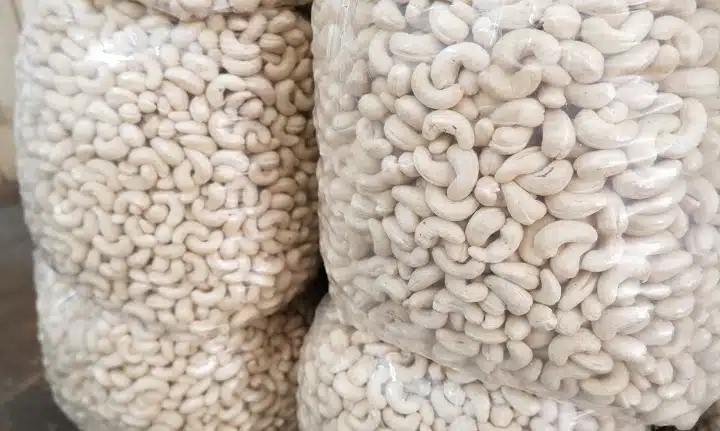
Cashew kernels are graded along three axes: colour (white/first-quality, scorched, dessert), size (measured as the count of kernels per pound), and wholeness (wholes, splits, butts, pieces). The main white-whole grades run from W180 — the largest, the “King of Cashews” — down to W500, where the number is the approximate count per pound, so a lower number means a bigger kernel. Alongside the whites sit scorched wholes (SW, heat-darkened), dessert grades (DW, deeper colour or blemish) and the broken grades — splits, butts and pieces. This page gives the full count-per-lb chart and a photo gallery of each grade; for the deeper dives see W320 (the benchmark) and W240 (the premium).
How Cashews Are Graded
Grading sorts kernels by the three axes above. Colour separates first-quality whites from heat-scorched and blemished dessert grades; size sorts the wholes into count-per-pound classes; and wholeness splits intact kernels from splits, butts and smaller pieces. The result is a standard set of codes — a “W” prefix for white wholes, “SW” for scorched wholes, and letter codes for the broken grades — codified by bodies such as the AFI and explained on the classification page.
White Whole Grades (Count per lb)
The count is the number of kernels in one pound — lower number, larger kernel.
| Grade | Type | Count per lb | Notes |
|---|---|---|---|
| W180 | White whole | ~170–180 | “King” — largest, highest price |
| W210 | White whole | ~200–210 | “Jumbo” |
| W240 | White whole | ~220–240 | Premium, uniform large kernel |
| W320 | White whole | ~300–320 | Benchmark, the most-traded grade |
| W450 | White whole | ~400–450 | Popular low-cost whole |
| W500 | White whole | ~450–500 | Small white whole |
Scorched Grades (SW)
Scorched wholes are kernels darkened to a light brown by longer or hotter roasting/drying. They come in the same size classes as the whites (SW180 through SW320 and beyond), and are nutritionally the same — only the colour differs, so they sell below first-quality whites.
Dessert Grades (DW)
Dessert wholes (DW) are deeper-coloured, speckled or blemished kernels that are still whole. They sit below scorched grades on price and suit uses where appearance matters less — cooking, pastes and ingredients.
Broken Grades: Splits, Butts, Pieces
Not every kernel survives whole. Splits (halved along the seam), butts (one cotyledon broken off), large and small white pieces (LWP/SWP) and baby bits (BB) are the same edible kernel, broken, and sell at a discount to wholes — ideal for confectionery, bakery and cashew butter.
Plan on roughly 75% wholes to 25% brokens in packed output. That figure sits inside every published range — the whole-to-split ratio varies between 55% and 85% of actual output depending on method and factory management, with 65% treated as the satisfactory standard, while a mechanised line is put at 75–90%. Anything above 85% packed wholes should be treated as a claim to verify rather than a number to budget on.
Two cautions. Packed wholes is not the same as the whole-cutting rate at shelling — the cutting figure is measured before peeling, grading and handling each take a further cut, so packed wholes is always the lower of the two. And the grade mix matters as much as the tonnage: most of what a plant loses is grade rather than mass, which is why two factories with identical outturn can post very different results. The factory guide’s KPI chapter prices what a point of grade is actually worth.
Cashew Grades Gallery
| Grade | Image |
|---|---|
| White Wholes – 180 | 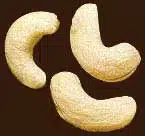 |
| White Wholes – 210 |  |
| White Wholes – 240 |  |
| White Wholes – 320 |  |
| White Wholes – 450 |  |
| White Wholes – 500 |  |
| Scorched Wholes (SW) – 180 | 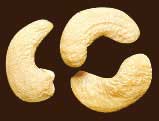 |
| Scorched Wholes (SW) – 210 | 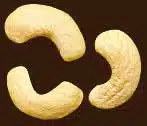 |
| Scorched Wholes (SW) – 240 |  |
| Scorched Wholes (SW) – 320 |  |
| Scorched Wholes (SW) – 450 |  |
| Scorched Wholes – 500 |  |
| Splits (S) |  |
| Large White Pieces (LWP) | 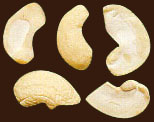 |
| Small White Pieces (SWP) | 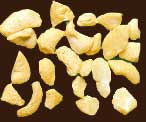 |
| Butts (B) | 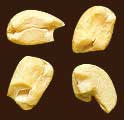 |
| Baby Bits (BB) | 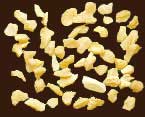 |
How Grading Is Done
Grading happens after peeling, in two steps: size grading on rotary or vibratory sieves that sort wholes into count classes, and colour/quality sorting — by hand-pick and, on larger lines, an optional optical colour sorter — to separate whites from scorched, spotted and defective kernels. See the cashew nut sorting machine and the buyer’s guide to choosing a grading machine.
Frequently Asked Questions
What do the numbers in W320/W240 mean? The number is the approximate count of kernels per pound: W320 is about 300–320 kernels per lb and W240 about 220–240. A lower number means fewer, larger kernels — so W240 is bigger than W320.
What is the highest cashew grade? W180, the “King of Cashews,” is the largest and highest-priced white whole grade at roughly 170–180 kernels per pound. W210 (“Jumbo”) and W240 follow.
What is the difference between scorched and dessert cashews? Scorched wholes are light-brown, heat-darkened but otherwise sound kernels. Dessert grades are deeper-coloured, speckled or blemished. Both are whole and edible, and both sell below first-quality whites.
Which cashew grade is best value? W320 is usually the best balance of quality and price — it is the benchmark, most-traded grade. Splits and pieces offer the same kernel, broken, at a lower price for cooking and ingredient uses.