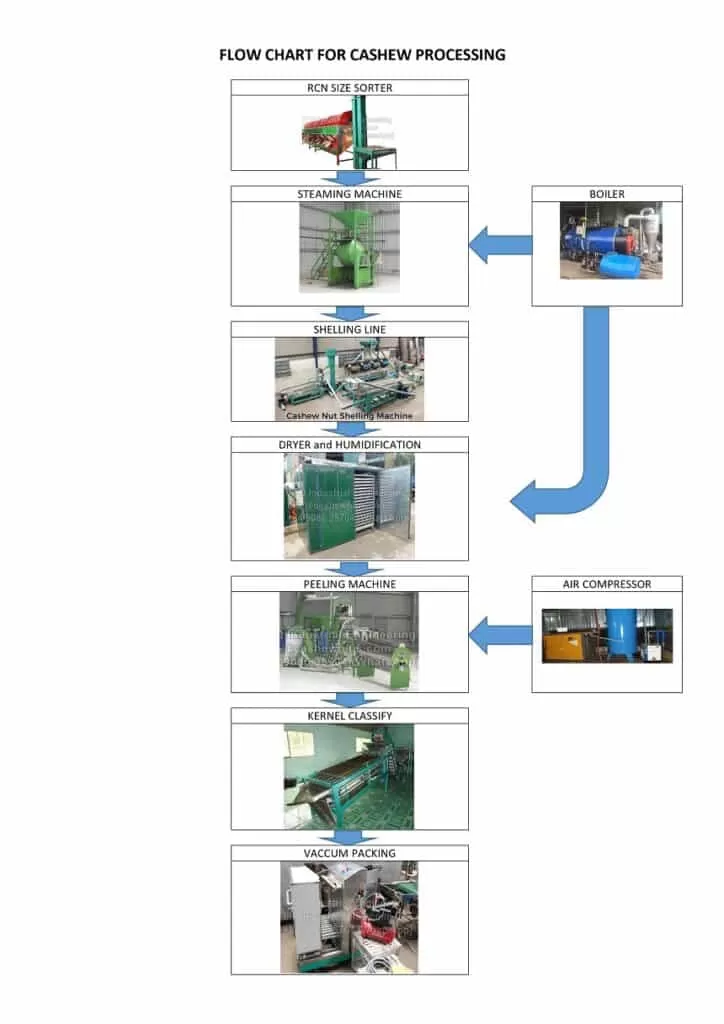
The cashew manufacturing process turns raw cashew nuts (RCN) into graded, packed kernels through a fixed sequence of stages: receiving and cleaning → calibration/sizing → conditioning (steaming or boiling) → cutting/shelling → scooping (kernel–shell separation) → drying → humidifying → peeling → grading/sorting → quality control → packing. Along the way about 22–24% of the raw-nut weight becomes kernel (the outturn), the rest being shell, testa and moisture. This page is the hub: it summarises each stage and the machine that does it, then links to the detailed guide for each. By-products — CNSL from the shell, and the testa — are recovered rather than wasted.
The Process at a Glance
| Stage | Purpose | Machine |
|---|---|---|
| Receiving & cleaning | Remove dust, dirt and foreign matter | — |
| Calibration / sizing | Sort raw nuts by size for even cutting | raw nut sorter |
| Conditioning (steaming) | Soften shell, neutralise CNSL, cut breakage | steaming machine + boiler |
| Cutting / shelling | Split the shell and release the kernel | cutting / shelling machine |
| Scooping | Separate kernel from cut shell | scooping machine |
| Drying (borma) | Reduce moisture and loosen the testa | dryer |
| Humidifying | Re-add slight moisture so kernels don’t crack | — |
| Peeling | Remove the testa skin | peeling machine |
| Grading / sorting | Sort by size and colour into grades | sorting machine |
| Quality control | Check moisture, defects, metal | — |
| Packing | Vacuum/nitrogen tins for export | vacuum packing machine |
Receiving, Cleaning & Calibration
Raw nuts arrive in ~80 kg bags, ungraded. They are cleaned of dust and debris, then calibrated by size on a rotary sorter so each nut sits in the right cutter setting — feeding random sizes into a cutter is the fastest way to raise breakage.
Conditioning (Steaming or Boiling)
The sized nuts are steamed (or, traditionally, boiled) to make the shell brittle and neutralise its caustic CNSL. This is the make-or-break step for whole-kernel recovery; the detail is on the cashew boiling process page.
Cutting / Shelling & Scooping
The conditioned nut is split by a cutting machine — manual, semi-automatic or a fully automatic cutting line — that opens the shell along its natural seam. The kernel is then separated from the shell halves by scooping. See automatic vs manual cutting for the trade-offs.
Drying, Humidifying & Peeling
Shelled kernels are dried in a borma/tray dryer to around 5% moisture, which shrinks the kernel and loosens the red-brown testa. The kernels are then lightly humidified so they flex rather than crack, and peeled in a peeling machine to reveal clean white kernels.
Grading, QC & Packing
Peeled kernels are graded by size (and, optionally, colour) into the export grades on a sorting machine, checked for moisture, defects and metal, then packed — usually vacuum/nitrogen-flushed tins — on a vacuum packing machine. See cashew packing for formats.
One step between peeling and packing is regularly left out, and it costs a container. The moisture ladder does not close on its own: drying takes the kernel down to 3–4%, humidification then puts one to two points back so it peels without shattering, and the packing specification is 3–5%. Moisture therefore has to come down again after peeling. Something must do that final conditioning, it handles graded product inside the finished-goods zone, and it is not the vacuum packer. A line commissioned without it ships its first container out of specification for a reason nobody on site can explain — see commissioning and the first season.
Yield & Outturn
The key number across the whole line is outturn — how much whole kernel survives. Typical recovery is about 22–24% of RCN weight; the levers that protect it (sizing, conditioning, cutting, drying, humidifying) are covered in yield optimisation, and the metric itself on the outturn formula page.
By-Products
Two streams add value: the shell becomes fuel for the plant’s own steam and a source of CNSL; the testa has feed and extract uses. A well-designed plant captures both — see the cashew shell burner. Beyond the machines, the full line can be delivered as a turnkey cashew processing plant.
Frequently Asked Questions
What are the steps in cashew processing? In order: receiving and cleaning, calibration/sizing, conditioning (steaming or boiling), cutting/shelling, scooping, drying, humidifying, peeling, grading/sorting, quality control and packing. Each stage has its own machine.
How long does cashew processing take? A raw nut passes through the line over hours to a day or two, with drying (often 10–12 hours) and humidification the slowest steps. Continuous plants run all stages in parallel, so throughput is set by the line’s rated capacity, not a single nut’s journey.
What is cashew outturn? Outturn is the amount of usable kernel recovered from raw nuts, expressed as pounds per 80 kg bag (KOR) or as a ~22–24% weight ratio. It is the main measure of processing quality — see the outturn formula.
Can cashew processing be automated? Yes. From automatic cutting lines and borma dryers to optical grading and vacuum packing, most stages can be automated and tied together in an ultra-modern unit — though calibrated feed and conditioning still matter to protect whole kernels.