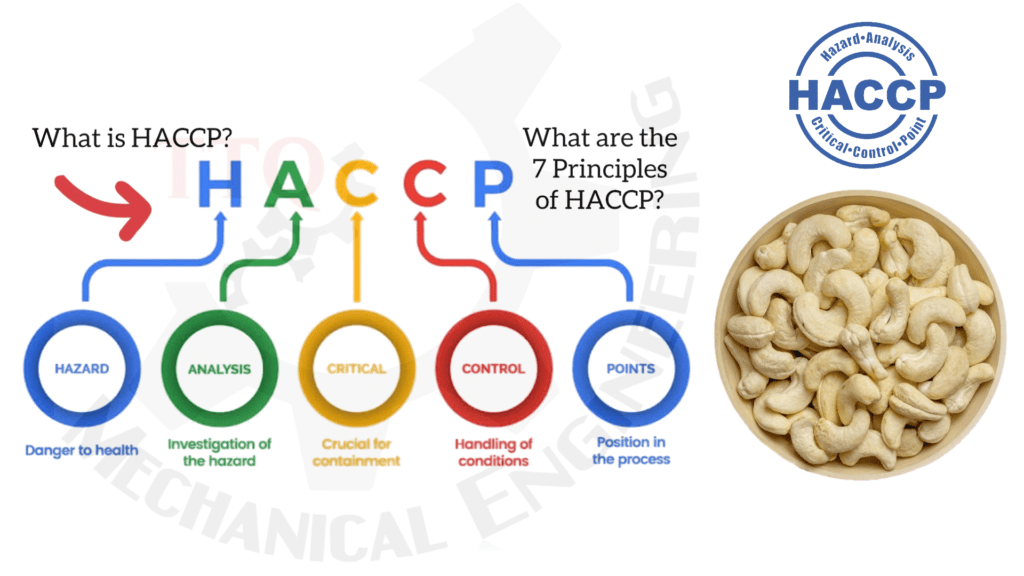
HACCP — Hazard Analysis and Critical Control Points — is the food-safety system export buyers expect from a cashew plant, and getting certified means building a documented programme rather than passing a one-off inspection. In practice you: run a hazard analysis (biological, chemical, physical), define critical control points (CCPs) such as drying/moisture, roasting temperature, metal detection and packing, put prerequisite programmes (GMP, hygiene, pest control) in place, and design clean/dirty zoning that separates the raw shell side from the kernel/pack side. Then you implement, verify, document and audit. Plant layout is the physical foundation of all of it. This page sets out the seven principles, the CCPs, zoning and the certification steps.
What HACCP Is & Why It Matters for Export
HACCP is a preventive system built on seven principles (codified by the Codex Alimentarius): hazard analysis, identify CCPs, set critical limits, monitor, take corrective action, verify, and keep records. For cashews, the food-safety management systems buyers recognise include HACCP, ISO 22000, BRC and the ACA Seal. Certification is often a condition of selling into North American and European markets, so it is a commercial gate as much as a safety one.
Prerequisite Programmes (GMP / SSOP)
Before CCPs work, the basics must be in place: Good Manufacturing Practice (GMP) and Sanitation Standard Operating Procedures (SSOP) — cleaning schedules, personal hygiene, pest control, water and waste management, and maintenance. These prerequisite programmes control the everyday hazards so the CCPs can focus on the critical ones.
Hazard Analysis
The analysis walks the whole line and lists hazards at each step: biological (mould/aflatoxin, microbial), chemical (pesticide residue, NaOH/cleaning carryover, CNSL), and physical (worker hair or nails, metal, glass, stone, shell fragments). Physical foreign matter is the single biggest safety concern in cashew, so it drives several controls.
Critical Control Points in Cashew Processing
| Step | Hazard | CCP / limit | Monitoring |
|---|---|---|---|
| Drying | Mould / aflatoxin | Moisture to ~5% | Moisture meter each batch |
| Roasting / conditioning | Under-processing | Target temp/time | Temperature log |
| Metal detection | Metal fragments | Reject any detection | Detector check per shift |
| Gravity / X-ray | Stone, glass, dense matter | Reject foreign matter | Line checks |
| Packing | Recontamination | Sealed, N₂/CO₂, correct pack | Seal & atmosphere checks |
Physical hazards are managed with gravity separators (stone, glass), metal detectors, and X-ray inspection as a final catch. Biological and chemical risks are controlled by cleaning (e.g. contact surfaces sanitised daily) and by verifying no cleaning-chemical carryover.
Hygienic Zoning (Raw vs Finished)
The plant is physically split into a dirty/raw side (intake, steaming, shelling, where shell dust and CNSL are present) and a clean/kernel side (drying, peeling, grading, packing), with controlled transitions, handwashing and separate personnel routes between them. This one-directional flow is exactly what auditors look for, and it is far cheaper to design in than to retrofit — see cashew factory layout & plant design.
Documentation & Records
HACCP lives or dies on records: the written plan, CCP monitoring logs, corrective-action records, verification results and traceability data. Auditors check that the system is not just written but running and recorded.
Certification Steps
Broadly: build the HACCP plan and prerequisite programmes → implement and start recording → run internally and correct non-conformities → engage a recognised certification body (for example SGS, Intertek, Ecocert or CISM, ideally GFSI-recognised) for audit → close findings and receive certification, then maintain it through re-audits.
Common Non-Conformities
The usual failures: weak documentation, poor separation of raw and clean zones, unmonitored CCPs (no moisture or metal-detector logs), inadequate pest control, and gaps in traceability. Fixing these before the audit is what the ultra-modern unit and consultancy help with. Personal hygiene and PPE — including food-grade gloves that protect cutters and peelers from caustic CNSL — are part of the prerequisite programmes an auditor will check.
Frequently Asked Questions
What is HACCP in cashew processing? A preventive food-safety system that identifies hazards, sets critical control points (like moisture, metal detection and packing), monitors and documents them — required by most export buyers and often a condition of sale.
What are the critical control points for cashews? Typically drying/moisture control (to prevent mould/aflatoxin), roasting or conditioning temperature, metal detection, gravity/X-ray removal of physical foreign matter, and sealed, atmosphere-controlled packing.
How long to get HACCP certified? It depends on the plant’s starting point — building the prerequisite programmes, plan and records and running them long enough to audit typically takes months, not weeks, before a certification body’s assessment.
Do I need HACCP to export cashews? In practice, usually yes. North American and European buyers generally require a recognised food-safety certification (HACCP, ISO 22000, BRC or the ACA Seal), so it is effectively a gate to export markets.