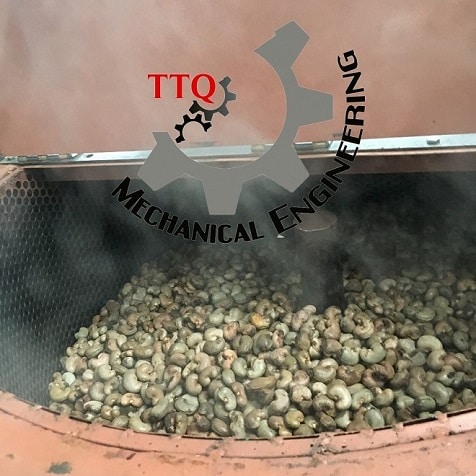
In a modern plant, “boiling” cashews means steam conditioning under pressure: raw nuts are cooked with saturated steam to make the shell brittle and neutralise its caustic CNSL, so the shell can be cut cleanly without breaking the kernel. It is a processing step, distinct from cooking boiled cashews for eating, and it is one of the biggest levers on whole-kernel recovery and plant profitability. A typical steaming cycle runs about 30–45 minutes per batch, after which the nuts go to cutting. This page explains what conditioning does, the parameters that matter, and how boiling, steaming and roasting compare.
What Boiling / Steam Conditioning Does
Conditioning targets the shell, not the kernel. Steam softens and embrittles the hard shell, loosens the kernel inside, and neutralises the caustic CNSL — all of which let a cutter split the shell along its seam with far less breakage. Getting it right is why a well-run plant holds a high outturn; getting it wrong drives up broken kernels, which sell at a steep discount.
Why Condition Before Cutting
A raw, un-conditioned shell is hard, oily and prone to shattering the kernel when cut. Steaming adds a little moisture and brittleness so the shell fractures predictably while the kernel stays whole and protected. It also makes the nuts safe to handle by neutralising the skin-burning CNSL.
Steam Boiler vs Open Boiling
Traditional open boiling (immersing nuts in water) has largely given way to pressurised steaming, which is cleaner, more uniform and easier to control, and keeps CNSL out of wastewater. Steam is raised in a boiler — often fired by the plant’s own shell waste — and piped to a vertical steaming machine, where saturated steam circulates through the batch.
Parameters (Time, Pressure, Moisture)
| Method | What it does | Typical cycle | Best for |
|---|---|---|---|
| Pressurised steaming | Saturated steam softens shell, neutralises CNSL | ~30–45 min/batch | Standard modern conditioning |
| Open boiling | Water bath softens shell | Longer, less uniform | Traditional / small-scale |
| Dry roasting | Heat embrittles shell (also extracts CNSL) | Minutes | Shell CNSL recovery |
The exact steam pressure and time are tuned to nut size and moisture; the aim is a brittle shell and an intact, slightly moist kernel.
Effect on Outturn & CNSL
Correct conditioning is the single biggest processing lever on whole-kernel outturn — a few percentage points of breakage saved flows straight to margin. Steaming also keeps CNSL contained in the shell (rather than dispersed in boiling water), so it can be recovered later as a by-product or burnt for fuel. See yield optimisation and CNSL extraction.
Boiling vs Steaming vs Roasting
All three apply heat, but for different ends. Boiling and steaming condition the shell ahead of cutting. Roasting applies dry heat — later, for kernel flavour, or in a hot-oil bath to extract CNSL from the shell. So conditioning comes first; roasting is a finishing or by-product step. See how to roast cashews.
Equipment Used
The conditioning line is a steam boiler (or shell burner) feeding a steaming machine; the same boiler usually also supplies heat to the drying rooms (dryer). Boiler capacity is sized to the number and size of steaming machines and dryers, plus any planned expansion.
Frequently Asked Questions
Why are cashews boiled before shelling? To make the shell brittle and neutralise its caustic CNSL, so the shell can be cut without breaking the kernel — which protects whole-kernel outturn and makes the nuts safe to handle.
What temperature are cashews boiled at? Conditioning uses saturated steam (around 100 °C and above, under pressure) rather than a set nut temperature; a steaming cycle typically runs 30–45 minutes per batch, tuned to nut size and moisture.
Is boiling the same as steaming cashews? They achieve the same end — conditioning the shell — but modern plants use pressurised steaming rather than open boiling, because it is cleaner, more uniform and keeps CNSL out of wastewater.
Does boiling affect cashew quality? Its main effect is protecting whole kernels through cutting, which safeguards grade and outturn. Done to the kernel’s flavour it is neutral; the target is the shell, not the taste.