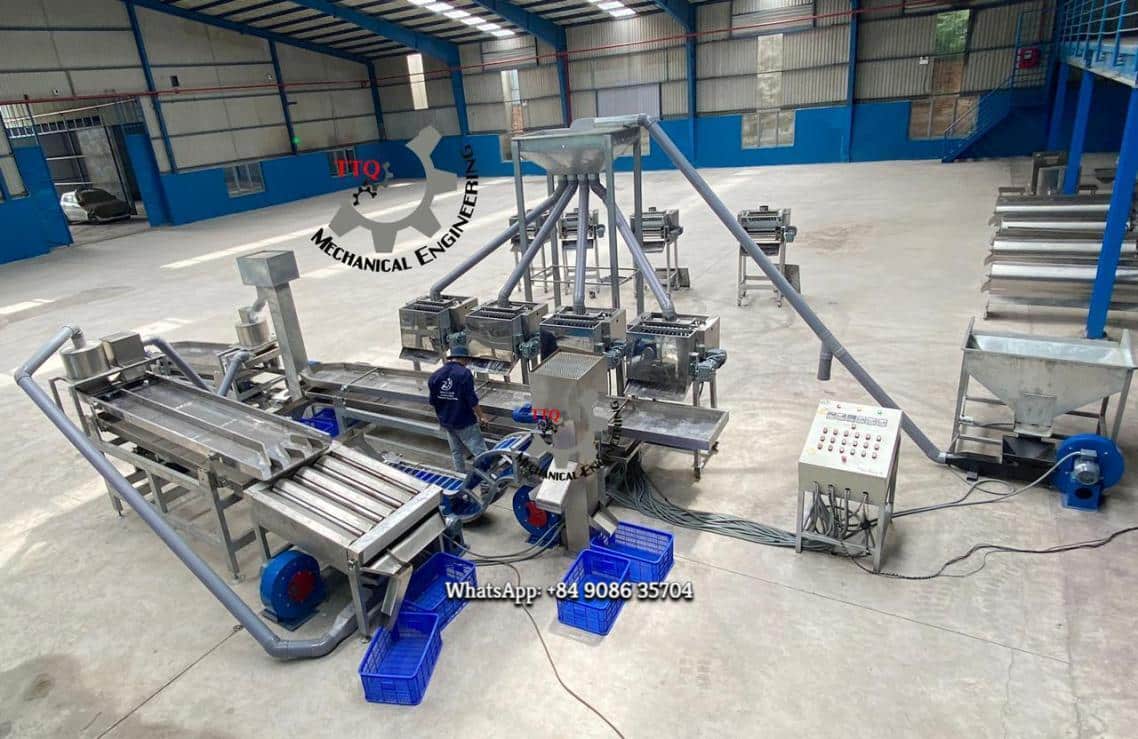
Automatic Cashew Cutting Line
Blade-based shelling — from a single hand-cutter to fully automated lines.
An integrated line that takes steamed raw nuts through cutting and scooping in one continuous, conveyor-linked flow — feeding, cutting, and separating kernel from shell with almost no manual handling. Where a single cutter is one station, the line chains a size sieve, a bank of powered cutters, and an automatic scooping screen so nuts move stage to stage on their own. CASHEW TECH builds these as single-, double-, or triple-sieve lines under one control panel, from a compact one-cutter setup up to a multi-cutter system. This page walks through the flow, the throughput, the scooping stage, and how the line compares with manual cutting.
How the Line Cuts and Scoops
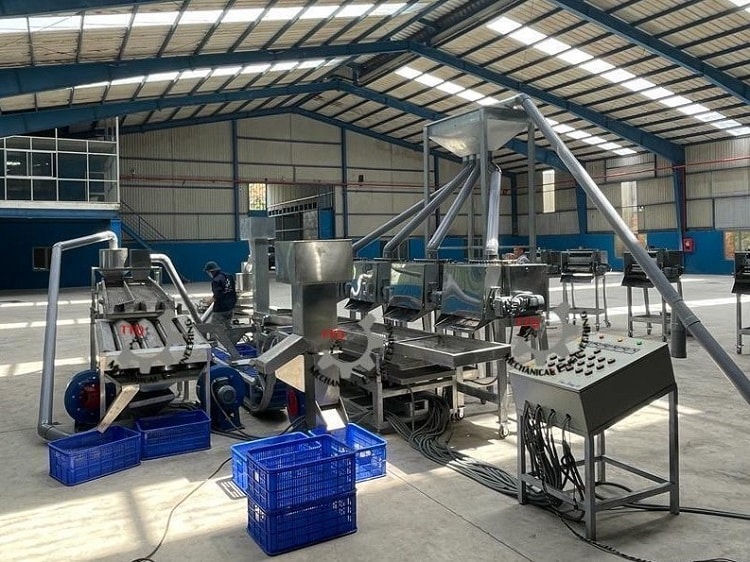
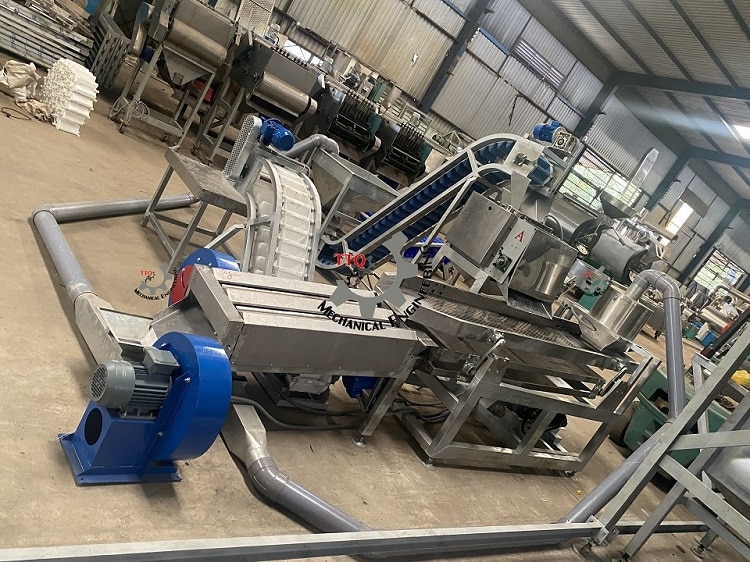
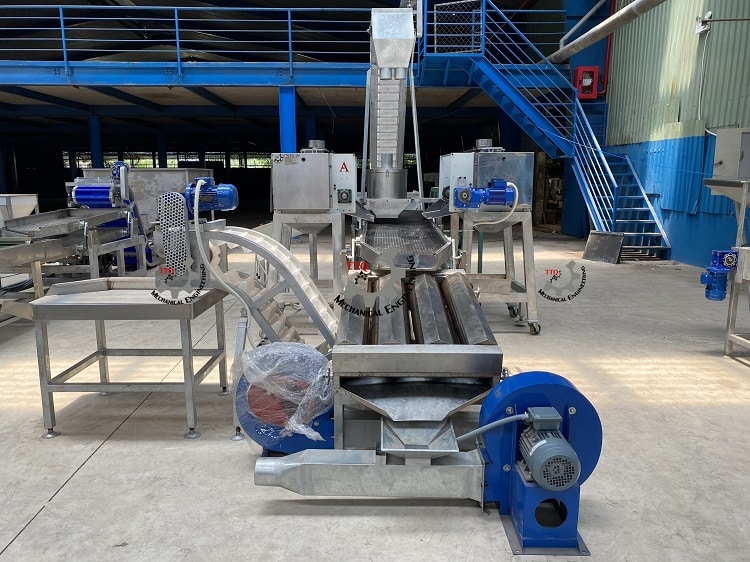
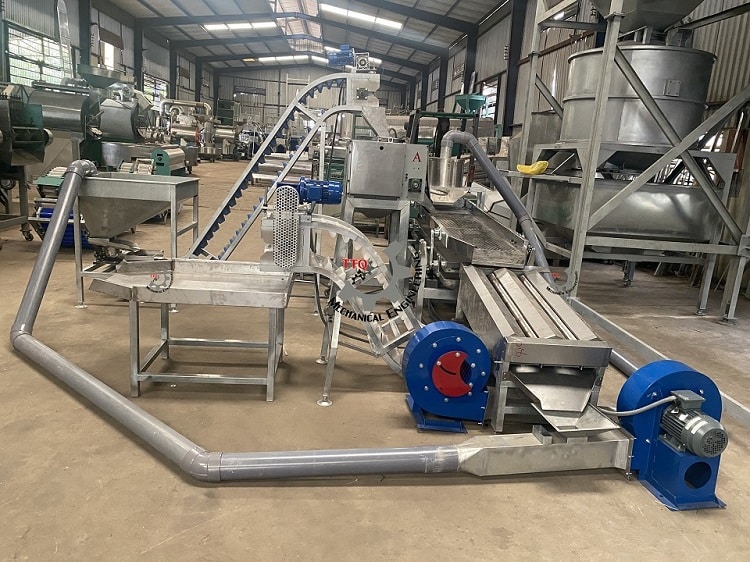
The line runs as one machine even though it is several. Steamed, size-graded nuts are elevated into a rotary sieve that holds each grade in the blade’s working range; from there they feed a row of powered cutters that shear the shell along the seam; and the opened nuts drop onto a vibrating scooping screen that lifts the loosened kernel away from the shell halves. The whole path — feed to discharge — needs only supervision, not hand-work, which is what lets a small crew match the output of a much larger manual floor.
Line Components
A typical line links five stages:
Automatic feeder / elevator: lifts graded nuts into the sieve without hand-loading.
Rotary size sieve: keeps every nut in the correct blade gap — the single biggest lever on whole-kernel yield.
Cutter bank: built from 8-head (~250 kg/hr) or 10-head (~300 kg/hr) units, shearing continuously.
Scooping vibration screen: separates kernel from shell with minimal damage, replacing the manual scooping table.
Discharge and shell take-away: routes clean kernels forward and shell to collection.
Each stage is matched to the next so no station starves or floods, which is what keeps the line at its rated throughput.
Capacity by Line Configuration
Line capacity scales with the number of cutter units and sieves it carries.
| Line configuration | Capacity |
|---|---|
| Single-sieve line | 300–350 kg/hr |
| Double-sieve line | 600–1,000 kg/hr |
| Triple-sieve line | 1,200–1,500 kg/hr |
Match the line to a daily target with room to spare, so the drying and grading stages downstream never wait on the cutters. A single-sieve line suits a first unit; a double- or triple-sieve line anchors a larger cashew processing plant.
Automatic Scooping: Separating Kernel from Shell
Scooping is what makes this a line rather than just a cutter. After the shell is cut, the kernel still sits inside the two shell halves; the cashew scooping machine — a vibrating, sieve-style screen — shakes the loosened kernel free and drops it onto the kernel conveyor while shell fragments fall away. Doing this mechanically instead of at a hand table protects the whole-kernel grade and removes one of the most labour-heavy jobs on the floor. Because each kernel is lifted the instant it comes free, it spends less time tumbling against sharp shell edges — one more reason a mechanical line tends to hold a higher whole-cashew grade than a hand floor.
The Cutter Units in the Line
Each cutter in the line is a fully automatic cutting machine in its own right — a spring-adjustable twin-blade unit that shears the nut and drops it to the scooping screen. Head count sets each unit’s throughput: an 8-head cutter runs around 250 kg/hr and a 10-head around 300 kg/hr, so multiple units combine into the line totals above. In practice most buyers start with a smaller line and add cutter units as raw-nut supply grows, since each cutter bolts into the same feed and scooping frame. For a standalone unit rather than a full line, see the cashew cutting machine page.
Manual vs Automatic Lines
The trade-off is labour against capital.
| Factor | Manual cutting floor | Automatic line |
|---|---|---|
| Labour needed | High — many operators for real volume | Low — a small crew per line |
| Output consistency | Varies with workforce skill | Steady, repeatable |
| Scooping | Hand tables | Vibration screen |
| Best for | Low-wage, small units | Scale, tight labour markets |
Where labour is scarce or costly, the line pays back on both cost per kilo and grade stability; the automatic vs manual cashew cutting guide runs the full comparison.
Power and Build
The line is frugal on power: each cutter unit runs on around 1 Hp, so overall draw scales modestly with the number of units. Build quality carries the rest — robust frames, replaceable cutting blades, and simple spring adjustment keep breakdowns low and let the line hold output shift after shift.
Where the Line Fits in Cashew Processing
In the cashew processing flow, this line sits between steaming and drying. Nuts arrive from the cashew steaming machine, pass through cutting and scooping here, and move on to the automatic cashew shelling machine or straight to the cashew dryer machine, then peeling and grading. The kernels leaving the line are clean enough to feed drying without a second handling, which is what keeps a modern factory’s labour count low from cutting through to packing. See the full cashew machines hub, the end-to-end cashew manufacturing process, or the blueprint for a modern cashew processing unit to place the line in a complete plant.
Request a Quote
Tell us your target daily capacity, your raw-nut origin, and your floor space, and we’ll size a cutting-and-scooping line and quote it. Request a quote or book a consultation, or message us directly on WhatsApp from the button in the corner of any page.
Watch it in action