Outturn, or Kernel Outturn Ratio (KOR), is the weight of usable kernel recovered from one standard 80 kg bag of raw cashew nuts (RCN), expressed in pounds — and it is the single most important number when pricing a raw-nut lot. The quick formula: take a 1 kg sample, cut-test it, and multiply the grams of good kernel by 0.176 to get KOR in lbs per bag. So 280 g of good kernel per kg ≈ 49 lbs outturn. Use the live calculator further down this page to estimate your own KOR from a sample, and read the bands below to see whether a lot is worth buying: broadly, under 40 lbs is poor, 47–50 is good, and 50–54 is excellent.
What Outturn (KOR) Means
KOR tells a buyer how much sellable kernel a bag of raw nuts will actually yield after shelling and peeling. Because processors buy RCN but sell kernels, outturn — not the raw price alone — decides whether a cargo is profitable. It is quoted as a number of pounds: “outturn 50” means 50 lbs of usable kernel per 80 kg bag. Two lots at the same RCN price can differ sharply in real value once their outturn is known.
The Formula & the 0.176 Conversion Factor
The factor 0.176 converts grams of good kernel from a 1 kg sample into pounds of kernel per 80 kg bag (it is simply 80 kg × 2.2046 lb/kg ÷ 1000). So:
KOR (lbs/bag) = good kernel (g per 1 kg sample) × 0.176
Worked example: a clean 1 kg sample yields 280 g of good kernel → 280 × 0.176 = 49.3 lbs outturn. Expressed as a percentage, that sample recovered about 28% good kernel by weight — the percentage-recovery view is covered on the raw cashew nut to kernel ratio page.
How to Use the Live Calculator
The calculator below (the KOR estimator panel) works from a cut-test of a 1 kg sample. Enter three weights: W1 the sample weight (~1000 g), W2 the weight of good whole kernels, and W4 the weight of the “50%-accepted” kernels (spotted or premature, counted at half value). It returns the % useful kernel. To convert that to pounds of outturn, multiply by about 1.76 — so 23.5% useful kernel ≈ 41 lbs, and 28% ≈ 49 lbs.
Reading the Bands (Reject / Good / Excellent)
Outturn bands are indicative and vary by origin — West African crops commonly run 48–50 lbs, while East Africa (Tanzania) and Indonesia often reach 51–54.
| Outturn (lbs / 80 kg bag) | Quality | Buyer action |
|---|---|---|
| Below 40 | Poor | Usually declined |
| 40–46 | Marginal | Negotiate hard |
| 47–50 | Good | Standard commercial buy |
| 50–54 | Excellent | Premium lot |
What Raises or Lowers Outturn
Outturn is set partly by the nut and partly by how it is handled. Larger, well-filled, low-defect nuts from a good origin start higher. Processing then protects or wastes that potential: correct sizing/calibration, careful conditioning, tuned cutting, gentle drying and humidifying before peeling all keep kernels whole, while breakage, over-drying and poor sorting drag outturn down. The levers are covered in yield optimisation.
Doing a Proper Cut-Test
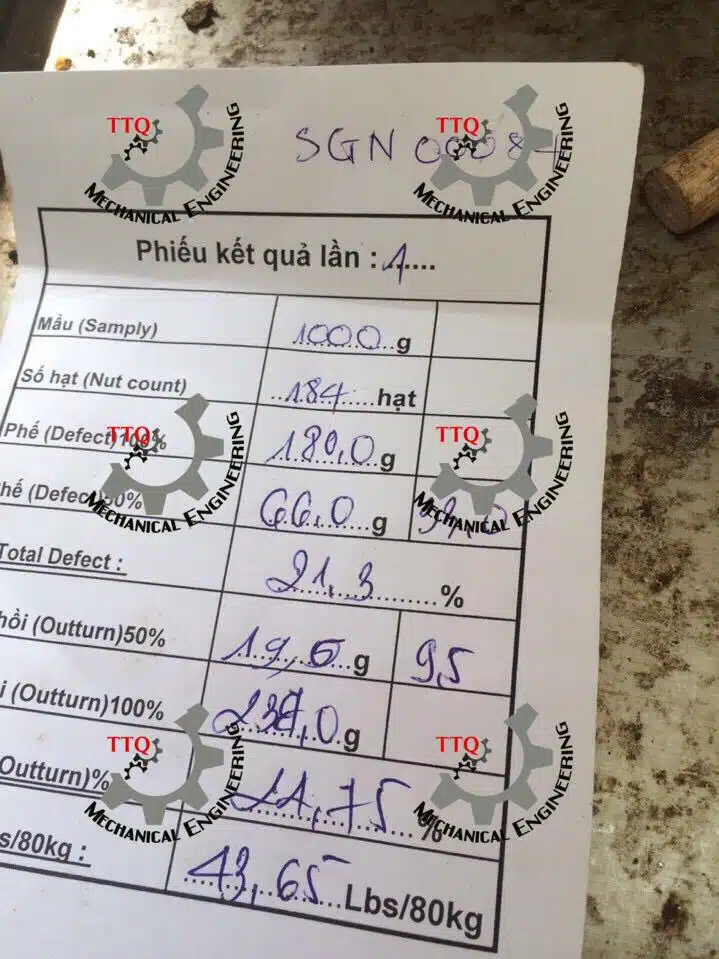
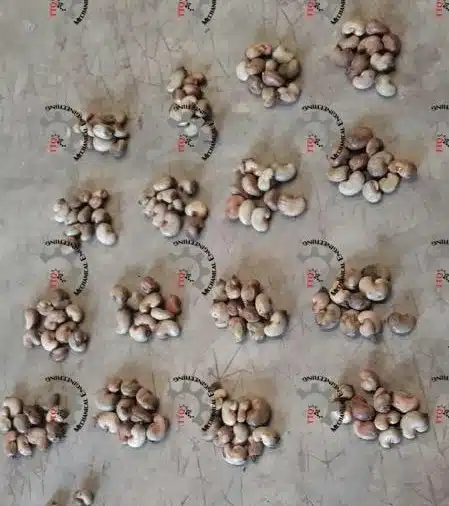
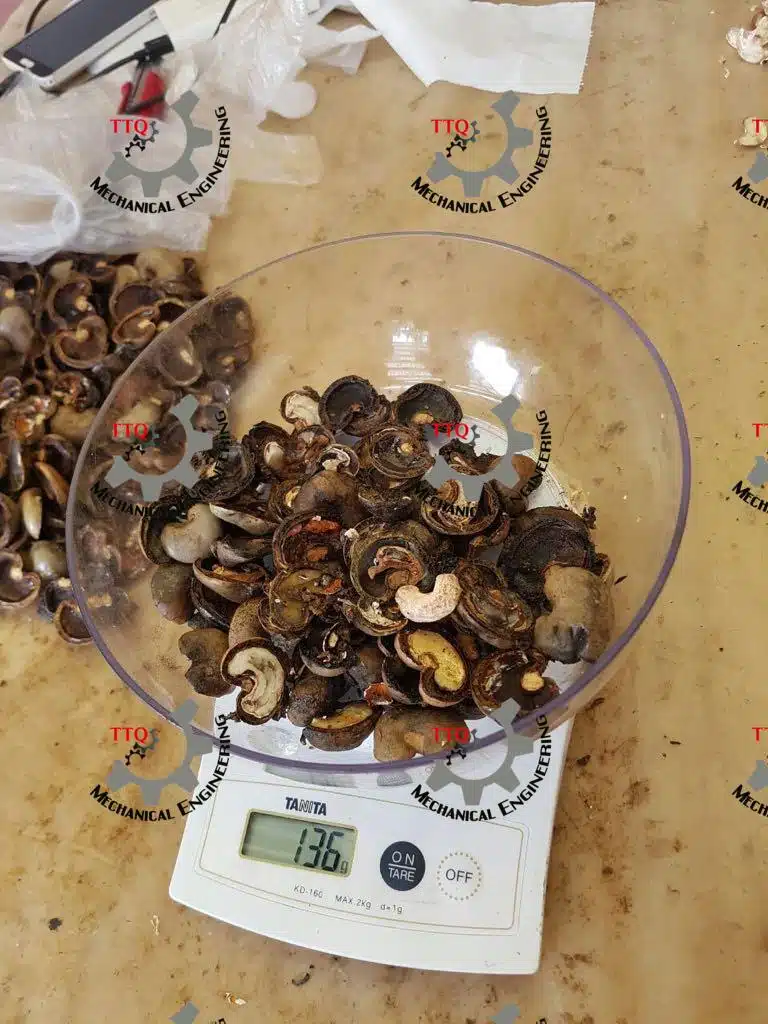
For a defensible number, take small handfuls from several bags, mix, and quarter the pile; draw a ~1 kg sample (W1) from opposite quarters and count the nuts (N) to get the nut count (N ÷ W1, typically 150–240 nuts/kg — fewer means bigger nuts). Cut every nut, then weigh the good whole kernels (W2), the 50%-accepted kernels (W4), and the fully rejected ones. From these:
- Nut count = N / W1
- Defective rate = (50%-rejected + 100%-rejected weights) / W1 × 100 (a lot above ~24% defect is usually rejected)
- % useful kernel = (W2 + W4⁄2) / W1 × 100 → KOR (lbs) ≈ % useful × 1.76
Method after comcashew.org — Calculating Outturn of Cashew Nuts.
Outturn vs Kernel Ratio (%)
Outturn (lbs/bag) and the RCN-to-kernel ratio (~22–24% by weight) are two different quantities, and treating them as one figure is a common and expensive modelling error.
Outturn is a cut-test on a sample. It measures the kernel a careful lab can recover from 80 kg of nuts, and it is what a lot is priced on.
The 22–24% ratio is production recovery. It is what your line actually packs and sells, after breakage, rejects, grading losses and handling.
The same 1.76 factor shows the gap plainly. A 48 lb cut-test is about 27%, and 52 lbs about 30% — while 23% production recovery is only about 40 lbs. The cut-test counts kernel that the line then loses.
A plan built on the cut-test figure therefore overstates revenue by roughly 10–15%. Use outturn to price a lot, and production recovery to plan capacity, revenue and financing. The factory guide’s KPI chapter works the arithmetic through, and the material balance chapter shows where the difference physically goes.
Frequently Asked Questions
What is a good cashew outturn? Around 47–50 lbs per 80 kg bag is a good commercial outturn, and 50–54 lbs is excellent. Below about 40 lbs a lot is usually rejected. Typical origins run 48–54 depending on crop and quality.
How do you calculate KOR from a raw nut sample? Cut-test a ~1 kg sample, weigh the good kernels (and half-count the spotted ones), and multiply the grams of good kernel by 0.176 to get pounds per 80 kg bag. The live calculator does this from your sample weights.
Why is the conversion factor 0.176? Because an 80 kg bag is 80 × 2.2046 = 176.4 lbs, so grams of kernel per kilogram of sample scale to pounds per bag by ×0.176 (176.4 ÷ 1000).
What outturn is too low to buy? Below about 40 lbs per bag is generally poor and rejected; 40–46 is marginal and only worth buying at a discount. Buyers also reject lots with more than roughly 24% defective nuts.