Africa grows over half the world’s raw cashew nuts — Côte d’Ivoire alone produces around 1.04 million tonnes — yet the continent has historically exported them raw to Asia (mainly India and Vietnam) for processing, losing most of the value. Turning that around means processing at source: cleaning → steaming/boiling → shelling → drying → peeling → grading → packing converts raw cashew nuts (RCN) into export-grade white kernels. Momentum is real — West African processing rose about 51% in 2025 as governments and investors build local capacity. This page explains the process and the continent’s raw-versus-processed story.
Africa’s Raw-vs-Processed Problem
The imbalance is stark: Africa exported the large majority of the world’s raw cashew, while India and Vietnam imported and shelled it — so kernels sell for several times the raw-nut price paid to African farmers, and that margin has flowed off the continent. Processing locally captures the kernel value, creates jobs, and shortens the supply chain for the ~3 million African smallholders who grow the crop.
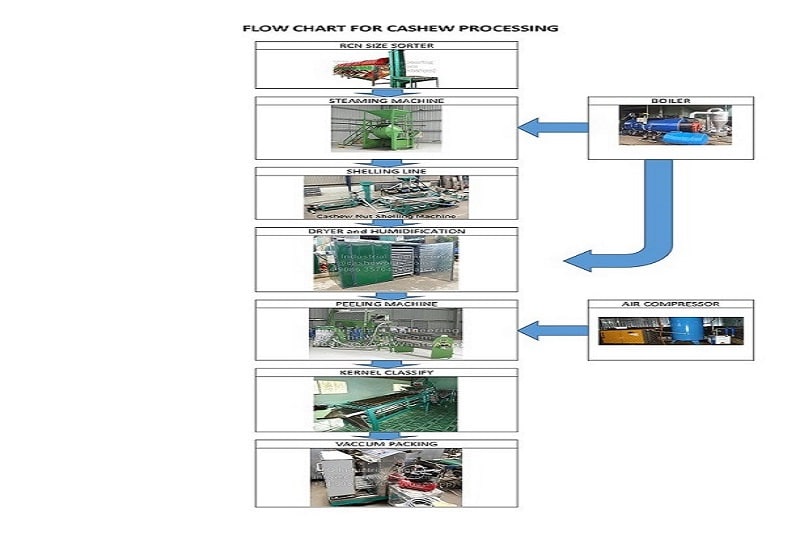
The Raw Cashew Processing Steps
Because the kernel is cushioned in a hard shell full of caustic CNSL, processing takes more steps than most nuts.
| Step | Purpose | Machine used | Output |
|---|---|---|---|
| Cleaning & sizing | Remove debris, calibrate by size | size sorter | Graded raw nuts |
| Steaming / boiling | Soften shell, neutralise CNSL | steaming machine | Conditioned nuts |
| Shelling / cutting | Split shell, release kernel | cutting machine | Kernel + shell |
| Drying | Reduce moisture (~5%), loosen testa | dryer | Dried kernels |
| Peeling | Remove the testa skin | peeling machine | White kernels |
| Grading | Sort by size and colour | sorting machine | Export grades |
| Packing | Vacuum/N₂ tins | vacuum packer | Export-ready product |
The full workflow is on the cashew manufacturing process page.
Why In-Country Processing Pays
Every tonne shelled in Africa instead of shipped raw keeps the kernel margin, the jobs and the by-product value (CNSL, shell fuel) on the continent. With the world’s deepest raw supply on the doorstep, African processors enjoy the shortest raw-material line of any origin — the barrier has been machines, power and know-how, which a turnkey partner supplies.
Country Snapshots
The leading African origins — Côte d’Ivoire (world #1), Benin (raw-export ban since 2024), Tanzania (East Africa’s leader), Ghana, Mozambique and Guinea-Bissau — are all covered in the West Africa hub and the producing-countries overview.
Building an African Processing Plant
Processors choose scale and technology to fit local realities — power, water, labour and secured supply. Plants can start small and expand, delivered as machines or a complete turnkey cashew processing plant, with installation and training on the ground.
Frequently Asked Questions
How is raw cashew processed into kernels? By cleaning and sizing the nuts, steaming to soften the shell and neutralise CNSL, shelling to release the kernel, drying, peeling off the testa, grading by size and colour, and packing under vacuum/nitrogen.
Why does Africa export raw cashew instead of processing it? Historically the continent lacked local processing capacity, so raw nuts were sold to India and Vietnam. Kernels then sold for several times the raw price — value that left Africa, which is why local processing is now a priority.
Which African countries process their own cashews? A growing number — Côte d’Ivoire, Benin (behind a raw-export ban), Tanzania, Ghana, Mozambique and others — with West African processing up about 51% in 2025.
What machines are needed to process raw cashew in Africa? A size sorter, steaming machine and boiler, cutting/shelling machine, dryer, peeling machine, grading/sorting machine and vacuum packer — available individually or as a turnkey line.