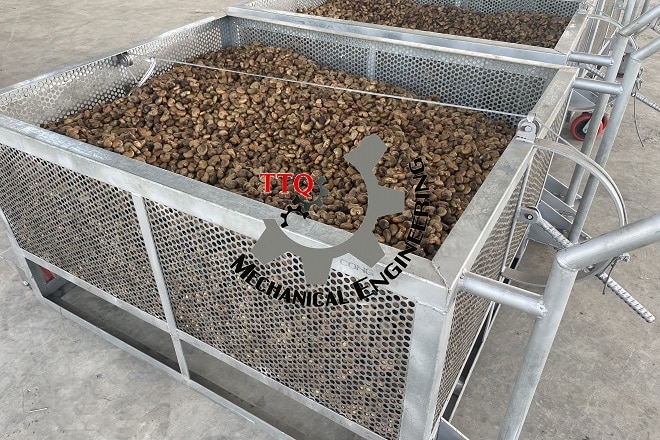
“Boiled cashews” refers to a processing step, not a recipe: raw cashew nuts are boiled or, in modern plants, steamed before shelling. The purpose is to soften the hard shell and neutralise the caustic cashew nut shell liquid (CNSL) inside, so the nuts are safe to handle and the shell can be cut without shattering the kernel. This conditioning step is what protects whole-kernel recovery — the single biggest driver of a processor’s margin. This page explains what boiling does, how it differs from roasting, and why steaming has largely replaced open boiling in industry. (It is distinct from cooking cashews for eating.)
What Boiled Cashews Are
In processing, “boiling” means immersing or steaming raw cashew nuts in shell to condition them ahead of cutting. It changes the shell, not the kernel: the shell becomes brittle and its CNSL is neutralised and loosened, readying the nut to be shelled. The step is also called steam conditioning — see the cashew boiling process for the industrial detail.
Why Cashews Are Boiled or Steamed
Three things happen at once: the shell softens so a cutter can split it cleanly; the caustic CNSL is neutralised, protecting workers and the kernel; and moisture is added so the kernel is less likely to crack during cutting. Skipping or botching this step drives up breakage — and broken kernels sell at a steep discount to whole ones.
Boiled vs Roasted Cashews
Both apply heat, but for different ends. Boiling/steaming conditions the shell (softening, CNSL neutralisation) ahead of shelling. Roasting applies dry heat, usually later, for flavour and moisture — or, in a hot-oil bath, to extract CNSL from the shell. So boiling comes before shelling; roasting is typically a finishing or by-product step. See how to roast cashews.
| Method | What it does | Typical use |
|---|---|---|
| Boiling | Softens shell, neutralises CNSL, adds moisture | Conditioning before shelling |
| Steaming | Same as boiling, cleaner and more controllable | Standard modern conditioning |
| Roasting | Dry heat for flavour or shell CNSL extraction | Finishing kernels; CNSL recovery |
How Boiling Improves Safety
Neutralising the CNSL is a safety measure as much as a processing one. Raw shell oil burns skin, so conditioning makes the nuts safe for cutters to handle and prevents the oil from tainting the kernel. This is the same reason cashews are never sold in shell.
Effect on Taste and Kernel Quality
Done right, conditioning has little effect on the kernel’s flavour — its job is the shell. Its real quality impact is indirect but large: proper steaming keeps kernels whole through cutting, protecting grade and outturn. Over- or under-conditioning, by contrast, raises breakage.
Boiling vs Steaming in Industry
Traditional open boiling has largely given way to pressurised steaming, which is cleaner, more uniform and easier to control, and keeps CNSL out of wastewater. Steam is raised in a boiler — often fired by the plant’s own shell waste — and delivered to a cashew steaming machine. See the steam boiler for the utility side.
Frequently Asked Questions
Why are cashews boiled before shelling? To soften the hard shell and neutralise the caustic CNSL inside, making the nuts safe to handle and letting the shell be cut without breaking the kernel — which protects whole-kernel yield.
What is the difference between boiled and roasted cashews? Boiling (or steaming) conditions the shell before shelling; roasting applies dry heat later for flavour, or in a hot-oil bath to extract CNSL. Boiling comes first; roasting is a finishing or by-product step.
Are boiled cashews safe to eat? Boiling is a processing step on the in-shell nut, not a finished snack. The nut still has to be shelled, dried and peeled afterwards. Once processed, the kernels are safe to eat.
Does boiling change the taste of cashews? Not much — conditioning acts on the shell, not the kernel flavour. Its main effect on quality is protecting whole kernels through cutting, which safeguards grade and value.