You never see cashews sold in the shell like peanuts or pistachios, and there is a simple reason: the cashew shell contains cashew nut shell liquid (CNSL), a caustic oil that irritates and blisters skin and mouth. A raw cashew “in shell” is a raw cashew nut (RCN) straight from the tree, and it must be steamed or roasted to neutralise the CNSL, then shelled and peeled, before it is safe to eat. This page explains what “cashew in shell” means, why in-shell nuts can’t be eaten raw, how processing makes them safe, and why the shelled kernel is the only form you’ll find on a shelf.
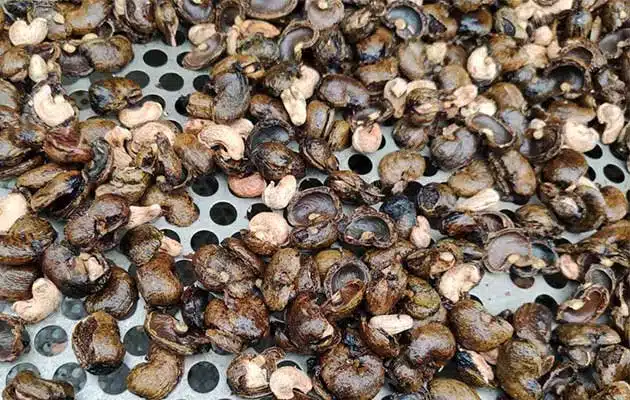
What “Cashew In Shell” Means
“In shell” simply means the raw cashew nut still inside its hard casing — the form the nut is traded in as a commodity (raw cashew nut, or RCN). It is not a snack format. The shell is the tough outer case; the edible kernel sits inside, wrapped in a thin skin (testa).
Why In-Shell Cashews Can’t Be Eaten Raw
Crack a raw shell and you expose CNSL. Its main components — anacardic acid and cardol — are phenols in the same family as poison-ivy urushiol, and contact can cause painful skin burns and blistering. Handling raw shells without protection is genuinely hazardous, which is why there is no “eat them from the shell” option.
The Caustic CNSL Problem
CNSL makes up roughly 25–35% of the shell and soaks the honeycomb layer around the kernel. Any processing has to keep this oil off the kernel and neutralise or contain it — otherwise the kernel is tainted and unsafe. Managing CNSL is the reason cashews take more processing than almost any other nut.
How Processing Makes Cashews Safe
Conditioning is the key step: the nut is steamed (or, traditionally, roasted) so the shell turns brittle and the CNSL is neutralised and driven off. Only then is the nut shelled to release the kernel, which is dried and peeled to remove the testa. The result is a clean, safe white kernel.
| Stage | Safe to eat? | Why |
|---|---|---|
| In shell, raw | No | Shell holds caustic CNSL |
| After steaming/roasting | Not yet | CNSL neutralised, but shell and testa still on |
| After shelling & peeling | Yes | Clean white kernel, oil and skin removed |
See boiled cashews for the conditioning step and the cashew steaming machine for the equipment.
Why Cashews Are Never Sold In Shell
Two reasons combine: safety (the CNSL hazard) and effort (opening the hard shell without cracking the kernel needs conditioning and machinery). Selling in-shell would hand consumers a dangerous, hard-to-open nut — so the industry does the processing and sells the finished kernel.
The Upside of In-Shell Handling
Trading the nut in shell is not all cost. The shell protects the kernel during transport and storage, and it carries value of its own: once removed, it becomes biomass fuel and a source of CNSL. So the “problem” shell ends up powering the plant and adding a by-product revenue line. For the botanical overview, see cashew nuts.
Frequently Asked Questions
Can you eat cashews straight from the shell? No. The shell contains caustic CNSL that irritates and blisters skin and mouth. The nut must be steamed or roasted, then shelled and peeled, before it is safe to eat.
Why are cashews sold without shells? Because the shell holds a hazardous oil and is hard to open without damaging the kernel. Processors condition and shell the nut, so consumers only ever see the finished kernel.
Is cashew shell poisonous? The shell’s CNSL is caustic and can cause severe skin irritation, so raw shells are handled with care and never eaten. Processing neutralises and removes it, leaving a safe kernel.
How are in-shell cashews made safe? By conditioning — steaming or roasting — which makes the shell brittle and neutralises the CNSL, followed by shelling, drying and peeling to produce a clean white kernel.