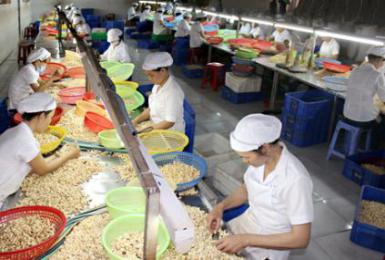
Cashew processing is one of the most labour-intensive food industries, and the labour is not spread evenly across the line. Cutting/shelling and peeling dominate the headcount, while steaming, drying and packing need far fewer people. So the labour question is really a cutting-and-peeling question — and that is exactly where automation changes the economics.
To put a rough sense on it (figures vary with capacity and method): a manual or semi-automatic plant can need anywhere from dozens to several hundred workers, most of them cutters and peelers. An automated line — automatic cutting, mechanical peeling, optical grading, conveying — can cut that headcount sharply. This is the decisive question for most buyers, because as wages rise across Africa and Asia, skilled hand-cutters get scarce and attrition is high, so labour is both the biggest operating cost and the biggest operational risk.
Why cashew processing is labour-intensive
The cashew kernel is fragile, curved and locked inside a hard shell lined with caustic shell liquid (CNSL). For decades the only way to get it out whole was skilled hands. Even today, much of the world’s crop is cut and peeled by people, not machines — which is why the industry is such a large rural employer, and why labour planning sits at the centre of any plant.
Where the labour goes (stage by stage)
| Stage | Labour intensity | Manual / semi-auto | With automation |
|---|---|---|---|
| Steaming / boiling | Low | Small crew | Small crew |
| Cutting / shelling | Very high | Most of the workforce | Sharply reduced |
| Scooping | High | Large crew | Reduced |
| Drying | Low | Small crew | Small crew |
| Peeling | Very high | Most of the workforce | Reduced to touch-up |
| Grading / sorting | High | Large crew | Low (optical sorter) |
| Packing | Medium | Moderate crew | Moderate crew |
The two “very high” rows — cutting/shelling and peeling — are where the money and the risk sit.
How many workers per ton (indicative)
Real, documented throughput gives the clearest picture. A two-person manual shelling station processes only about 30 kg of raw nuts a day, and a manual peeler handles roughly 3–5 kg of kernels a day. Multiply that across a plant’s daily tonnage and it is easy to see why cutting and peeling swallow the headcount — and why cutting time and throughput are watched so closely.
The rising cost of labour
Wages are climbing across the major processing regions, skilled cutters are getting harder to find, and attrition is high — so a plant that leans entirely on hand labour carries a cost that rises every year and a supply of skill that is never guaranteed.
Reducing labour with automation
The levers are specific: an automatic cutting line for shelling, a peeling machine for the testa, an optical sorting machine for grading, and a scooping machine plus conveyors to move material. Mechanical peeling rarely removes 100% of the testa, so it is usually paired with a small manual touch-up crew — the headcount falls, it doesn’t vanish.
Labour vs capital: the trade-off
There is a genuine tension. Manual cutting tends to give a higher whole-kernel recovery (a careful hand breaks fewer kernels) but needs far more people; automation lowers labour and risk but asks for capital and can shift the grade mix. The right balance depends on local wages, scale and the value of whole kernels — see yield optimisation for the recovery side and plant cost for the capital side.
Automation ROI & payback
The payback on automation is driven by the wage bill it removes against the capital it costs, so it is fastest where wages are high and volumes are large. Because both sides vary so much by country and capacity, the honest answer is a worked case, not a headline number — we size the manpower and model the payback for your specific plant.
Planning your manpower
A fully automated unit is one end of the spectrum and a hand-cutting cottage plant the other; most processors sit in between and evolve. Cashew Tech helps size the manpower for your capacity and supplies the automation that reduces it — talk to us about the balance that fits your market via contact. For the roles a plant hires, see cashew factory jobs & careers.