Cashew grading is really two different jobs, and choosing a machine starts with knowing which you need. Size grading sorts kernels (or raw nuts) into count classes — the W-grades, or A+–D for raw nuts — using rotary or vibratory sieves. Quality/colour sorting separates white kernels from scorched, spotted and foreign material, and is done by hand-pick and, on larger lines, an optional optical (CCD) colour sorter. Match the machine to your bottleneck first, then compare capacity, accuracy, changeover and after-sales support. This page explains the two types, how they map to the grades, and what to check before buying.
Two Kinds of Grading (Size vs Colour)
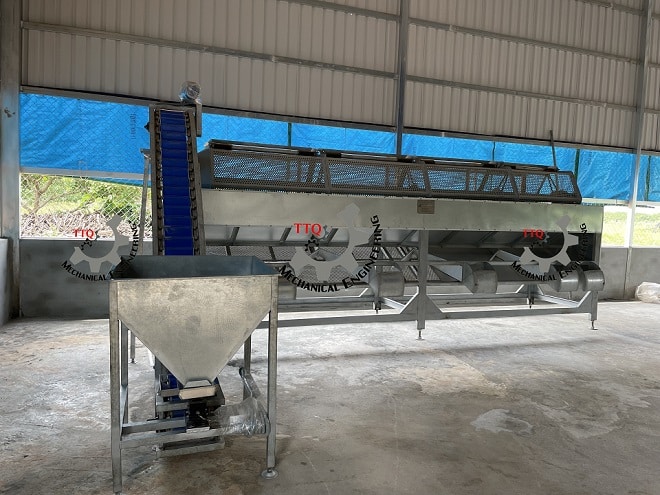
Size grading is mechanical and near-universal: rotary/roller graders drop kernels through graduated openings into size classes. Colour/quality sorting is optical: cameras spot and air-eject off-colour or defective kernels. Every plant needs size grading; colour sorting is an add-on for consistency where buyers demand it — we supply and advise on both as part of a complete sorting and grading line.
Size Graders (Sieve / Rotary)
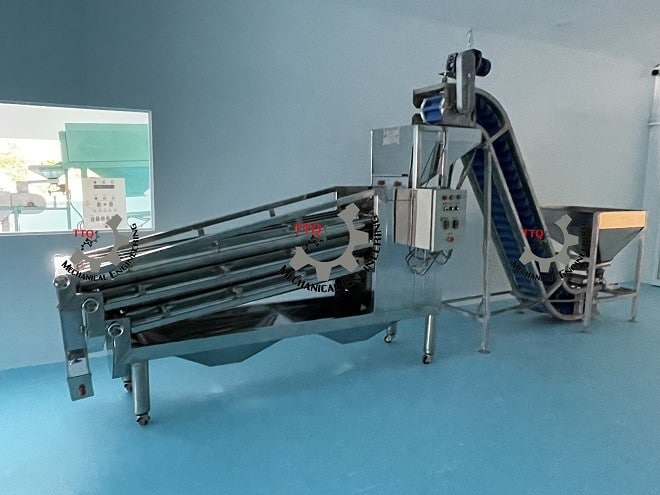
For raw nuts, a rotating drum with graduated holes sorts nuts into 3–5 size grades (A+, A, B, C, D) at capacities from a few hundred kg/hour up to ~2 tons/hour, so each size feeds the right cutter setting. For kernels, a rotary roller/axis grader classifies wholes by count into W240, W320, W450 and brokens — larger machines (more rollers/axes) simply run more throughput.
Optical / Colour Sorters
An optical colour sorter uses cameras (CCD) and LED lighting to detect scorched, spotted or foreign kernels and air-eject them at high speed. It delivers the consistent whites premium buyers expect, but adds capital cost and needs clean, single-layer feed. It complements — does not replace — size grading.
Matching Grades to AFI / W-Standards
Whatever the machine, the output has to map onto the recognised grades and classification — count-per-pound size classes and colour classes under the AFI specification. Choose a machine whose size classes and accuracy actually hit the grades your buyers name.
Capacity & Accuracy
Size the machine to your line’s throughput (kg/hour) at the stage it serves, and check its accuracy/reject rate — a size grader’s classification accuracy (well-run kernel sorters hold ~90–95%) and, for optical sorters, the false-reject rate and ejector reliability. Under-sizing throttles the line; over-sizing wastes capital.
What to Check Before Buying
| Check | Why it matters |
|---|---|
| Grading job (size vs colour) | Buy for your actual bottleneck |
| Capacity (kg/hr) | Must match the line stage |
| Accuracy / reject rate | Protects grade and yield |
| Changeover ease | Fast switch between grades |
| Cleaning / anti-clog | Sieves clog without a cleaning roller |
| After-sales & spares | Uptime in a remote plant |
Integration in the Line
Raw-nut size grading sits before cutting (to calibrate feed); kernel grading and colour sorting sit after peeling, just before packing. Plan power, footprint and material flow so graders don’t become the bottleneck — the factory layout handles this.
Frequently Asked Questions
What machine grades cashew nuts? Two types: a size grader (rotary/sieve) that sorts by count into W-grades or raw-nut size classes, and an optional optical colour sorter that removes off-colour and defective kernels. Most plants need the size grader; colour sorting is an add-on.
Do I need a colour sorter or a size grader? Every plant needs size grading. A colour sorter is worth adding when buyers demand very consistent whites and your volumes justify the capital — otherwise hand-picking after size grading can suffice.
How accurate are optical cashew sorters? Good optical sorters eject the large majority of off-colour and foreign kernels, while size graders typically hold around 90–95% classification accuracy. Feed quality (clean, single-layer) strongly affects both.
How are cashews graded into W320/W240? By count per pound: a kernel size grader drops wholes through graduated openings so W240 (~220–240/lb) and W320 (~300–320/lb) separate into their classes, matched to the grade chart.